In 2021, I just wanted to be a great recruiter. Understand clients, engage candidates, close positions. Make money. Survive. Little did I know that overtime I’ll mostly become a management accountant.
Act 1: Survival
Back in 2021, we made the decision to pivot away from products and focus entirely on recruitment services.
The question Ravi and I were trying to answer was simple:
Can the two founders actually sell recruitment services and deliver on those mandates?
Because if we couldn't, there wasn't much point continuing, we'll shut the business down and go back to jobs.
Fortunately, a few folks trusted us with their hiring needs and we delivered. One client became two, two became three, and slowly it started feeling like this thing might actually work.
Recruitment felt simple then. A candidate joins, the client pays, you remove some costs, keep some money aside, reinvest a little and split the rest.
Act 2: Growth
Jilian joined, the business grew, and we started adding more service lines.
One of them was staffing. Almost overnight, invoice values became larger. The top line trended up and to the right.
If you had told me 2021 that a we’d make a few Crores in Revenue, I would've been thrilled. And I was.
For the first time, it felt like we were building a "real" company.
Act 3: The Realisation
Looking back, I thought recruitment and business were the same thing.
They weren't.
Recruitment taught me sourcing, screening, client management and delivery.
Business forced me to learn a completely different language.
Revenue.
Net Fee Income (NFI).
Profit.
Cash flow.
Margins.
Incentives.
Unit economics.
Suddenly numbers that had looked impressive started looking very different.
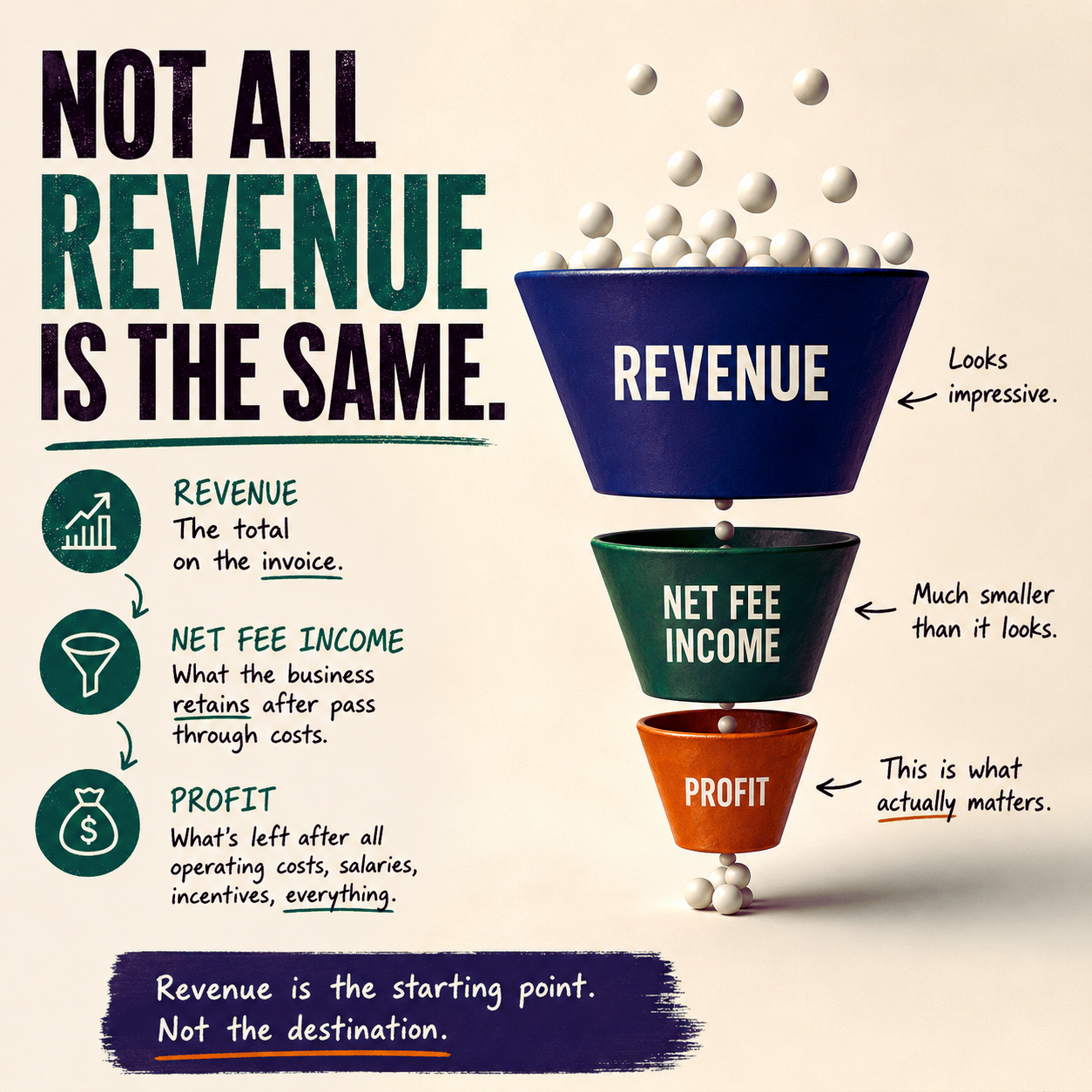
Staffing gave us the top line, mostly pass through, and thin NFI
Contingent gave us smaller numbers, but high NFI
After all this came the salaries, incentives and operating costs which created an entirely different conversation around profitability.
For the first time, revenue stopped being the answer.
It became the starting point.
Act 4: How It Changed My Thinking
Once I started tracking NFI, I began looking at the business differently.
Which service lines were actually contributing?
Which ones looked impressive but added very little?
Which opportunities should we pursue?
Which ones should we politely walk away from?
Today, NFI is probably the single most important number I track.
Not because revenue doesn't matter.
Because NFI helped me understand the economic reality of the business instead of just its size.
Was there a metric that completely changed the way you looked at your business once you started tracking it?